
Hello,
dear Reader,
I’m delighted that you’ve found your way to this companion service page for my book Between the Lines.
It tells me that you have a genuine interest in storytelling—and that your curiosity has been sparked by the many best-practice examples featured in the book.
Here, you’ll find—chapter by chapter—links to all the stories, campaigns, and projects mentioned throughout the book. I hope this additional material will inspire your own storytelling journey.
Warm regards, Petra Sammer
For those who don’t have the book yet, simply click here:
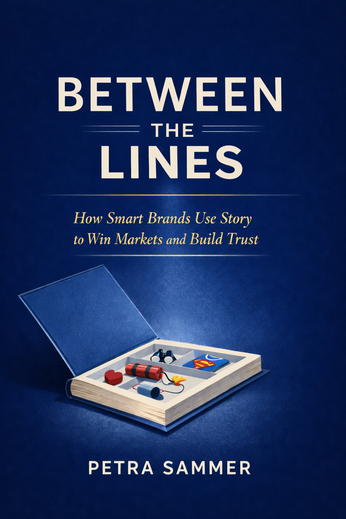
Between the Lines is the English adaptation of Petra Sammer's acclaimed book "Storytelling", which has already reached its successful third edition and is widely regarded as one of the most influential titles on storytelling in the marketing and corporate communications of the DACH region.
"Between the Lines" is a inspiring, intelligent, and highly practical book that provides real value for both newcomers and experienced marketing and PR professionals alike." - Amazon review

Chapter 1
In a world where we’re simply overwhelmed with information—where it’s hard to tell fact from fiction and where we’re flooded with content—great stories are more essential than ever. Despite the overload, the appetite for stories remains strong. So what’s needed are great storytellers—are you one of them? In the first chapter, we dive into the world of emotional storytelling and take a look at some of the greatest brand stories of recent years:
-
Siemens: Helping Hand - https://www.youtube.com/watch?v=s5Tj5eReQY0
-
Edeka: #Coming Home - https://www.youtube.com/watch?v=V6-0kYhqoRo
-
Edeka: Supergeil - https://www.youtube.com/watch?v=gtfOeAGyuwg
-
Gillette: This Father's Day, Go Ask Dad - https://www.youtube.com/watch?v=0m9WLRMkYRA&t=27s
-
Ariel: Share the Load - https://www.youtube.com/watch?v=vwW0X9f0mME (Campaign: https://www.ariel.in/en-in/about-ariel/share-the-load/the-share-the-load-journey)
- Coca-Cola: Content 2020 Initiative Strategy Video - https://www.youtube.com/watch?v=G1P3r2EsAos&t=13s

Chapter 2
-
Mercedes-Benz: Bertha Benz—The Journey That Changed Everything - https://group.mercedes-benz.com/company/news/international-women-s-day-2019.html
- Volkswagen: Kombi's Last Wishes - https://www.youtube.com/watch?v=1ZuG2meedNs
Chapter 3
-
Heider-Simmel Experiment - https://www.youtube.com/watch?v=VTNmLt7QX8E
-
Future of StoryTelling: Paul Zak—Empathy, Neurochemistry, and the Dramatic Arc - https://vimeo.com/61266150
-
Uri Hasson: TED Talk This is your brain on communication - https://www.ted.com/talks/uri_hasson_this_is_your_brain_on_communication
-
Philips: Wake up the Town – Arctic Experiment - https://www.youtube.com/watch?v=jMm4TXXTpIg
-
Patagonia: Worn Wear Stories - https://vimeo.com/81574196 (Campaign
website: https://wornwear.patagonia.com/)
-
PepsiCo: Pepsi Commercial Starring Kendall Jenner - https://www.youtube.com/watch?v=uwvAgDCOdU4 (background information - https://astute.co/pepsi-kendall-jenner-commercial/)
-
IKEA: DJ Hary loves records - https://www.youtube.com/watch?v=tq0kKBzzq5w
-
ZEISS: Connected Care on the Lofoten Islands - https://www.zeiss.com/corporate/en/c/stories/insights/connected-care.html
-
ZEISS: RealTalk - https://www.zeiss.com/career/en/working-at-zeiss.html
-
Birkenstock: Birken Stories – https://www.youtube.com/channel/UCsDtI51c5Ieo3GNKDK9v-6A - and on Birkenstock's corporate website: https://www.birkenstock.com/gb/magazine/birkenstories/
- ON: The Right To Race - https://www.youtube.com/watch?v=D_QzSVS3FPY and on ON's corporate website - https://www.on.com/de-de/stories/the-right-to-race-dominic-lokinyomo-lobalus-journey-to-the-olympics
Chapter 4
The ingredients of a compelling story are many—but five elements are truly essential. From your perspective, what makes a story effective? This chapter offers an overview of these five key components, which will be explored in greater depth in the chapters that follow. First, take a look into this story:
- British Airways India: A Ticket to Visit Mum - https://www.youtube.com/watch?v=WPcfJuk1t8s
Chapter 5
Every good story has a meaningful reason to be told. Do you know your reason why? This chapter explores the principle of the “purpose-driven idea” and why it is essential to effective storytelling. The best-practice examples that follow bring this concept to life:
-
Birkenstock: Ugly for a Reason - https://www.birkenstock-group.com/de/en/detail-press/ugly-for-a-reason/
-
Birkenstock: Birkenstories - https://www.birkenstock.com/de-en/magazine/birkenstories/
-
Simon Sinek: TED Talk How Great Leaders Inspire Action - https://www.ted.com/talks/simon_sinek_how_great_leaders_inspire_action
-
FedEx: The FedEx Panda Express: Chengdu to Toronto - https://www.youtube.com/watch?v=tzhnzaEGrbY
-
Coca-Cola: Small World Machines—Bringing India & Pakistan Together - https://www.youtube.com/watch?v=ts_4vOUDImE
-
Coca-Cola: Christmas Commercial 2020 -
https://www.youtube.com/watch?v=euSHNXRMJvQ
-
Nike: How Steve Prefontaine set the pace for Nike - https://about.nike.com/en-GB/magazine/steve-prefontaine-fighting-spirit
-
Nike: Colin Kaepernick - https://www.youtube.com/watch?v=jBnseji3tBk
-
Harley-Davidson: Operation Personal Freedom - https://www.youtube.com/watch?v=3x-RprfFyyY
-
Dove: Dove Evolution - https://www.youtube.com/watch?v=wpM499XhMJQ
-
Dove: Beauty never gets old - https://www.youtube.com/watch?v=Y6aYY9yRMfA
-
Dove: Nutri Duo: The Story behind the campaign - https://www.youtube.com/watch?v=7RC9PpfQj3w
-
Dove: #ShowUs - https://www.dove.com/za/stories/campaigns/showus.html
- Andrew Stanton: TED Talk - The clues to a great story - https://www.ted.com/talks/andrew_stanton_the_clues_to_a_great_story
Chapter 6
Storytelling is more than just a communication technique—it can become an organizing principle. Has your company already evolved into a narrative-driven organization? This chapter explores what defines such companies, illustrated by the following examples:
-
Steven Denning: TEDx Talk – Leadership Storytelling - https://www.youtube.com/watch?v=RipHYzhKCuI
-
Apple: Official Designed by Apple in California - https://www.youtube.com/watch?v=0xD569Io7kE
-
Apple: Mother Nature – Apple 2030 - https://www.youtube.com/watch?v=KXJw_ZLR7PA
-
Hartmann: Hartmann Stories - https://www.hartmann.info/en-gb/customer-solutions/healthcare-professional/hartmann-stories
- Dove: Real Beauty Sketches - https://www.youtube.com/watch?v=rrHoDJinMQI
Chapter 7
Every good story has a hero. That may sound like a cliché—but what does it really mean? This chapter clarifies what “hero” actually signifies in the context of storytelling for marketing and PR and shows you how to identify the right protagonist for your narrative. The following stories offer useful guidance:
-
Matthew Winkler: What makes a hero? - https://www.youtube.com/watch?v=Hhk4N9A0oCA
-
IKEA: DJ Hary loves records - https://www.youtube.com/watch?v=tq0kKBzzq5w
-
Guinness: Gareth´s Story - https://www.youtube.com/watch?v=EFeo2epi-Lw
- Johnson & Johnson: 5B—A Documentary of the Heroes of San Francisco - https://www.youtube.com/watch?v=d3D7IWTohps

Chapter 8
-
Kurt Vonnegut: On the Shapes of Stories - https://www.youtube.com/watch?v=oP3c1h8v2ZQ
-
IKEA: Start something new - https://www.youtube.com/watch?v=AfERQ-Riy2E
-
Dorian Lebherz / Daniel Titz: Dear Brother - https://www.youtube.com/watch?v=h2caT4q4Nbs
- Honda: The Power of Dreams: Failure—Secret to Success -https://www.youtube.com/watch?v=iJAq6drKKzE

Chapter 9
Every good story moves us emotionally. Storytelling is the antithesis of purely rational, fact-based communication. But how do you bring genuine emotion into corporate communications without coming across as awkward or forced? This chapter offers practical tips and techniques, along with the tools you need to make your messaging more emotionally engaging. Take a look at these examples as well:
-
Philips: The Longest Night - https://www.youtube.com/watch?v=IO93NnfzbMc
-
Brené Brown: Brené Brown on Empathy vs. Sympathy - https://www.youtube.com/watch?v=KZBTYViDPlQ
-
Dove: Mary´s story - https://www.youtube.com/watch?v=L3qc6QjfJyc
-
Alfred Hitchcock: Psycho (shower scene) - https://www.youtube.com/watch?v=iHaImemSffg
-
Sergio Leone: Once Upon a Time in the West (opening scene) - https://www.youtube.com/watch?v=8Kg0vgzwPz8
-
Stanley Kubrick: 2001: A Space Odyssey - The Dawn of Man - https://www.youtube.com/watch?v=ypEaGQb6dJk
- Stanley Kubrick: 2001: A Space Odyssey – The Blue Danube - https://www.youtube.com/watch?v=0ZoSYsNADtY

Chapter 10
We live in the age of the visual turn. Images are playing an increasingly central role in how we absorb information, often eclipsing text altogether. PR must learn to communicate more through visuals and less through words. This chapter will help you do just that. This videos are helpful to learn the "visual language":
-
Lewis Bond: Color in Storytelling - https://www.youtube.com/watch?v=aXgFcNUWqX0
- Red Bull: Stratos Space Jump - https://www.redbull.com/int-en/projects/red-bull-stratos
Chapter 11
Storytelling in marketing and PR now takes place largely online. What matters is which stories are clicked, commented on, and shared. But what makes a story valuable enough to go viral? This chapter shows why you need to think and plan far beyond any single story—illustrated by these examples as well:
-
Old Spice: The Man Your Man Could Smell Like - https://www.youtube.com/watch?v=owGykVbfgUE
-
Old Spice: Response Campaign Re: @Jsbeals -Old Spice - https://www.youtube.com/watch?v=_-fLV28SkZ8&t=50s
-
Old Spice: Response Campaign Re: @Kmanchester - Old Spice - https://www.youtube.com/watch?v=1OjspFzE7sM
-
Old Spice: Case Study - https://www.youtube.com/watch?v=Kg0booW1uOQ
-
MAERSK: This is your brain on change - https://www.youtube.com/watch?v=GN-H_qPBVn4
-
Apple: The Underdogs - https://www.youtube.com/watch?v=JJwdhWM9d0Y
- Snow World - https://www.youtube.com/watch?v=jNIqyyypojg

Chapter 12
-
Carole Cadwalladr: TED Talk Facebook's role in Brexit — and the threat to democracy - https://www.ted.com/talks/carole_cadwalladr_facebook_s_role_in_brexit_and_the_threat_to_democracy
-
Continental: Heartbeat Stories - https://www.continental.com/en/company/history/150-years/heartbeat-stories/
-
Andrew Stanton: TED Talk The clues to a great story - https://www.ted.com/talks/andrew_stanton_the_clues_to_a_great_story
-
Volkswagen: Kombi's Last wishes - https://www.youtube.com/watch?v=1ZuG2meedNs
-
MSPlus: This bike has MS - https://www.youtube.com/watch?v=mPUTgvWTKkI
-
Traffic Authority Victoria: Meet Graham - www.meetgraham.com.au
-
Procter & Gamble: Thank You Mom - https://www.youtube.com/watch?v=BnBvlz8EaZ0
-
Visit Bern: #IloveBern with Heidi - https://www.youtube.com/watch?v=0A3ikSy7jzU
-
Montblanc: Let´s Write - https://www.youtube.com/watch?v=nn59j75Q1Mc
- VW Brazil: Gerações #VW70Anos - https://www.youtube.com/watch?app=desktop&v=MfEzXKUVKJc
Chapter 13
Today, the stories we tell reflect how we imagine the world of tomorrow—and, in doing so, we take responsibility for what that world will become. What future stories are you telling? This chapter offers a forward-looking perspective on how we can—and should—use storytelling, and the role that companies, brands, and each of us plays in shaping it. These are the stories to explore:
-
Siemens Healthineers: Magnetic Stories (Case Study) - https://www.youtube.com/watch?v=PJGgMzJb8qc
-
Nike: KAEPERNICK NIKE AD - https://www.youtube.com/watch?v=jBnseji3tBk
-
Patagonia: The Last Observers - https://eu.patagonia.com/se/en/films/the-last-observers/
- ZEISS: Wim and Donata Wenders sharing a love for film - https://www.youtube.com/watch?v=RLVf65jx1f4

pssst... more books, videos ...
If you’re looking for even more information, inspiration, and insights on storytelling in marketing and PR? Take a look at the SAMMERy Storytelling Library. There, you’ll find over 200 book recommendations, reviews, and reference resources.